
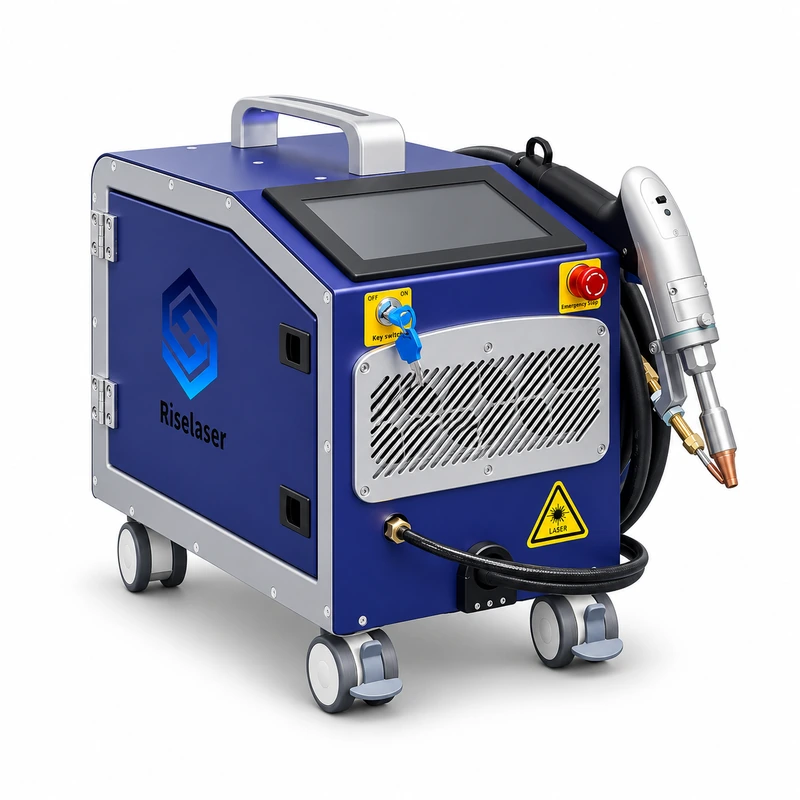
Five Processes for Everyday Metalwork
Spot weld small components, run a seam, trim thin sheet, remove surface contamination, and clean weld discoloration with the RLW-FH600-NAS. Change the front-end gun components to move between jobs.

Prepare, join and finish the workpiece
A repair may need rust removed before welding and dark oxide marks cleaned afterward. This laser welder cutter cleaner lets operators carry out those tasks using one main unit and the appropriate gun components. Review how to prepare the metal surface before joining when planning the cleaning step.
The five modes cover QCW precision spot welding, continuous wobble welding, thin-sheet cutting, surface cleaning and weld discoloration removal.
| Process | What the machine helps you do |
|---|---|
| QCW precision spot welding | Place localized welds on small hardware, thin nickel strips and titanium-alloy lap joints. Adjust pulse settings to manage heat input and backside marking. |
| Continuous wobble welding | Join stainless steel, carbon steel and galvanized sheet. Use the built-in wire feeder when the joint requires filler. |
| Thin-sheet cutting | Trim or separate suitable stainless steel, carbon steel and aluminum sheet using the cutting head. |
| Surface cleaning | Remove rust, paint or oil from suitable metal surfaces after testing the process on the actual coating and substrate. |
| Weld discoloration removal | Clean dark oxide marks around a weld to reduce the manual finishing needed for the required appearance. |
Control Heat on Small and Thin Parts
Deliver energy where the joint needs it while controlling heat spread into the surrounding metal.
The QCW source combines pulse-based precision spot welding with continuous-modulated operation. Adjustable waveforms and power ramp-up and ramp-down settings help operators tune the weld and control spatter. Read about how pulse timing and continuous output affect heat input when comparing the processes.
For cosmetic parts, evaluate backside marking and distortion alongside weld penetration and strength during a sample test.

Reach the Joint with Less Weight in Your Hand

A gun weighing 900 g or less
The lightweight gun reduces the weight the operator holds while positioning the beam. The standard 5 m armored fiber gives the operator reach around different areas of a workpiece.
Coaxial red-light aiming helps locate the processing area before laser emission. Select the front-end components for the required process and follow the prescribed setup procedure.
Air cooling in a compact unit
The 516 × 300 × 388 mm machine fits beside a prepared work area. Air cooling removes the need to connect a water chiller for this configuration.
Keep the cooling inlets clear and operate within the specified 0–36 °C ambient range.

Return to Proven Settings When Repeat Work Arrives
Separate recipes for different processes
The 7-inch touchscreen provides at least 19 independent process recipes. Save the settings after a sample meets the job requirements, then recall the recipe for the next run.
Chinese, English, Russian and other supported interface languages help teams work with the same machine settings.


Feed filler wire when the joint calls for it
The built-in feeder keeps wire delivery with the machine during seam-welding work. Choose the filler according to the base metal, joint fit-up and required weld profile. Our guide explains when a joint benefits from added filler wire.
Include the actual joint gap and material thickness in the sample test so the welding setup reflects the work on your bench.
See the Handheld System in Use
RLW-FH600-NAS Technical Specifications
| Parameter | Specification |
|---|---|
| Product model | RLW-FH600-NAS |
| Laser source | QCW quasi-continuous-wave fiber laser |
| Processing modes | Precision spot welding, continuous wobble welding, cutting, surface cleaning and weld discoloration removal |
| Laser wavelength | 1,080 ± 5 nm |
| Peak power options listed in specification | 600 W / 1,000 W. Confirm the supplied configuration in the quotation. |
| Fiber core diameter | 14 μm, customizable |
| Standard fiber length | 5 m |
| Focused spot size | 0.1–4 mm |
| Specified stainless steel welding thickness | 0.3–2 mm |
| Specified stainless steel cutting thickness | 0.5–2 mm |
| Adjustable cleaning width | 5–80 mm |
| Handheld gun weight | ≤900 g |
| Control interface | 7-inch touchscreen |
| Process recipe storage | ≥19 independent recipes |
| Laser emission control | Gun trigger and safety clamp |
| Aiming system | Coaxial red-light positioning |
| Shielding gas connection | Single argon or nitrogen connection. Flowmeter optional. |
| Cooling | Air cooling |
| Power supply | AC 220 V ±10%, 50/60 Hz |
| Total machine power consumption | ≤1.8 kW |
| Machine dimensions (L × W × H) | 516 × 300 × 388 mm |
| Listed machine weight | Approx. 26 kg, with a 5 kg wire load noted in the specification |
| Operating ambient temperature | 0–36 °C |
| Relative humidity | ≤70%, non-condensing |
| Interface languages | Chinese, English, Russian and other supported languages |
| Laser safety classification | Class 4 |
| Safety functions | Emergency stop, key lock, overtemperature protection, laser alarm and safety clamp |
Thickness ranges are specified for stainless steel. The specification notes reduced welding capability on aluminum and copper. Confirm the material, joint and required result through a sample test.
Match the Process to Your Workpiece
Small hardware and precision joints
Evaluate localized welds on precision hardware, nickel strips, nickel-plated steel strips and titanium-alloy components. Provide each layer thickness and the joint drawing for the sample test.
Sheet-metal fabrication and repairs
Use seam welding on suitable stainless steel, carbon steel and galvanized sheet for small enclosures, doors, windows and repair components. Select filler wire for the joint and base material.
Equipment refurbishment
Remove rust or a coating from a suitable metal surface before repair welding, then use weld cleaning to address dark oxide marks around the repaired area.
Thin-sheet trimming
Use the cutting mode for short trimming and separation tasks. Submit the material, cut length, thickness and edge requirements when requesting a demonstration.
Prepare a Controlled Laser Work Area

Machine controls and site precautions
The machine includes an emergency stop, key lock, overtemperature protection, laser alarm and safety clamp. Use the Class 4 laser in a controlled work area with appropriate barriers, restricted access and trained operators.
Select protective eyewear for the 1,080 ± 5 nm wavelength range and the optical density required by the hazard assessment. Provide suitable fume extraction for welding, cutting and cleaning, especially when treating painted or coated metal.
Keep the area clear of flammable materials. Inspect protective lenses regularly and replace damaged or contaminated consumables according to the maintenance instructions.
Before cleaning a full surface, test a small representative area. Check for remaining rust or paint, discoloration and substrate damage. Adjust the settings gradually and save the recipe after the finish meets the job requirements.
Configuration, Warranty and Remote Service
Standard configuration
- QCW five-in-one laser main unit and multifunction handheld gun.
- Built-in wire feeder.
- Spot-welding head, wobble-welding head and cutting head.
- 5 m armored delivery fiber and safety clamp.
- One pair of laser protective glasses.
- Power cable, spare protective lenses and assembly tools.
- Export wooden-crate packaging.
Ask for the quote to identify the cleaning components and consumables supplied for all five modes.
Support for setup and process questions
Protective lenses, sealing rings, fiber heads and gun nozzles are consumables excluded from warranty coverage.
Service includes remote process adjustment, video after-sales guidance and process-parameter sample testing support.
When contacting support, send the material, thickness, selected mode, settings and photos of the result. Include any error message shown on the screen.
Frequently Asked Questions
What does QCW mean for this machine?
Is 600 W or 1,000 W the continuous output power?
Can the machine weld without filler wire?
Can it remove paint and rust without damaging the surface?
Does this configuration need a water chiller?
Can it weld copper to aluminum?
What details should I send for a quote?
Discuss Your Welding, Cutting or Cleaning Job
Send a representative workpiece or photos with material and thickness details. A sample test can assess weld penetration, backside appearance, cut quality or coating removal before you choose the configuration.
Request a Quote and Sample TestInclude the details that define the job
- Material and thickness
- Required processing modes
- Joint drawings or workpiece photos
- Required weld, edge or surface finish
- Expected daily workload
- Delivery destination