
Surface preparation for laser welding is the single most critical step in achieving a high-quality, defect-free joint. Unlike traditional arc welding, which can tolerate some surface impurities, laser welding requires near-surgical cleanliness.
The most effective cleaning method for modern industrial applications is laser cleaning (ablation). This process removes oxides, oils, and hydrocarbons in a single pass without using chemicals or abrasive contact.
A single fingerprint on a titanium part or a patch of oxide on aluminum can lead to catastrophic joint failure. Contaminants cause porosity, cracking, and lack of fusion defects that result in costly scrap and downtime.
Manufacturing is rapidly moving away from chemical solvents. Solvents are dangerous to operator health and costly to dispose of. Laser cleaning offers a precise, green, and easily automated alternative that integrates directly into production lines.

The 3 Methods of Surface Cleaning
To choose the right method, you need to weigh speed, cost, and quality. Here is how the three main approaches compare.
Laser Cleaning
How it works: This method uses high-intensity light pulses to vaporize contaminants (ablation) and strip oxides (spallation). It does this without damaging the base metal. Many shops now utilize a 4 in 1 laser welder, which includes a cleaning function to prep the surface immediately before welding.
Best for: Inline automation, laser cleaning for welding prep on steel, and stripping oxide from aluminum.
Key Benefit: Selectivity. The laser beam cleans the specific weld track perfectly while leaving the surrounding material untouched.
Chemical Cleaning
Solvents (Acetone/MEK): These are effective for removing surface oils but cannot remove heavy oxides or mill scale.
Acid Pickling: This is necessary for deep cleaning, such as removing the alpha-case from titanium. However, it is hazardous to workers and creates expensive waste disposal issues.
Alkaline Degreasing: Safer than solvents, but this method requires rigorous rinsing and drying. If the part isn’t perfectly dry, moisture will cause laser welding defects like porosity.

Mechanical Cleaning
Wire Brushing/Grinding: This is a cheap, manual method, but it is highly inconsistent.
The Risk: Mechanical methods often “smear” contaminants into the metal pores rather than removing them.
Rule: Never use a steel brush on aluminum or an aluminum brush on steel. This causes cross-contamination, introducing foreign particles into the weld pool.
Comparison: Laser vs. Chemical vs. Mechanical
| Feature | Laser Cleaning | Chemical Cleaning | Mechanical Cleaning |
| Precision | High (Targeted area) | Low (Whole part) | Low (Inconsistent) |
| Oxide Removal | Excellent | Varies by chemical | Moderate |
| Environmental | Green (Fume extraction) | Hazardous Waste | Dust/Particulates |
| Consumables | None (Electricity only) | Solvents/Acids | Brushes/Discs |
| Risk of Damage | None (Non-contact) | Chemical etching | Surface scratching |
Material-Specific Surface Cleaning Process
Different metals react differently to contaminants. Here are the specific protocols for the most common industrial materials.
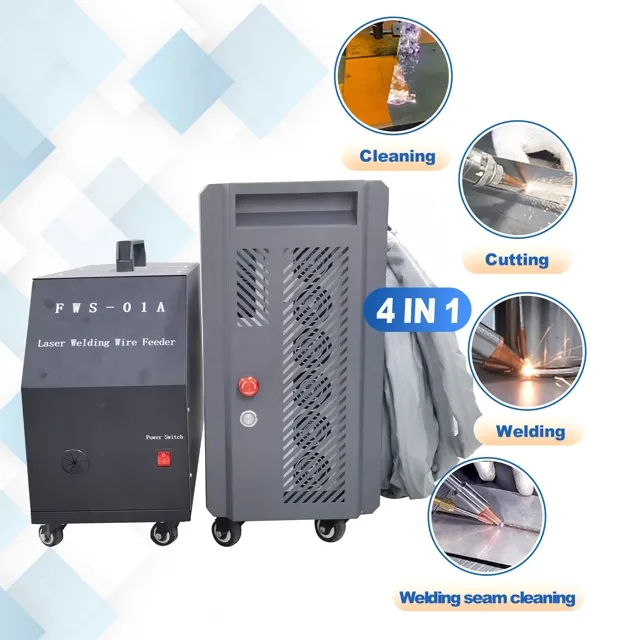
Maximize your shop’s efficiency
The Riselaser RL-FLA is a 4-in-1 air-cooled system that seamlessly switches between welding, cutting, seam cleaning, and surface preparation.
How to Clean Aluminum for Laser Welding
Aluminum Oxide (Al₂O₃). The oxide layer melts at 2072°C, while the aluminum underneath melts at only 660°C. If you don’t remove the oxide, it won’t melt during welding, acting as a solid inclusion in the weld pool.
- Degrease First: Remove oils with Acetone or an Alkaline cleaner. Never wire brush an oily surface; you will drive the oil into the metal.
- Deoxidize: Use aluminum oxide removal techniques like laser ablation (nanosecond pulses) or a clean stainless steel wire brush. If brushing, brush in one direction only to lift the oxide away.
- Time Limit: Weld immediately. Aluminum begins to re-oxidize instantly upon contact with air.
How to Clean Titanium for Laser Welding
Hydrogen, Oxygen, and Nitrogen. Titanium acts as a “getter” material—it absorbs these elements from the air or surface contaminants when hot, leading to embrittlement.
- The “White Glove” Rule: Handle parts only with lint-free nitrile gloves. Fingerprints contain oils and salts that lead to cracking.
- Solvent Wipe: Use Acetone or Methyl Ethyl Ketone (MEK).
- The Forbidden Chemical: NEVER use Chlorinated Solvents (like TCE or Brake Cleaner). Laser radiation interacts with chlorides to form deadly gas.
How to Clean Carbon & Galvanized Steel
Mill scale, Rust, and Zinc coatings.
- Rust/Scale: Laser welding cleaning settings (typically ~4.26 J/cm²) effectively remove rust and mill scale to expose bare metal.
- Galvanized Steel (Zinc): You must remove the zinc coating from the joint interface (de-galvanizing). Zinc boils at roughly 906°C. If present during welding, it vaporizes explosively and blows out the weld, causing spatter and porosity.
Why Surface Clean is Critical for Laser Welding Quality
Why do we obsess over surface preparation for laser welding? Because laser optics and physics are unforgiving.
- Absorption Issues: Dark oxides absorb laser energy differently than shiny, bare metal. This creates “hot spots” and leads to an unstable keyhole, resulting in inconsistent penetration depth.
- Hydrogen Porosity: Hydrocarbons (oils, grease, shop fluids) dissociate into hydrogen when hit by the laser plasma plume. This hydrogen gets trapped in the weld pool as it freezes, creating bubbles (porosity). Preventing weld porosity starts with degreasing.
- Spatter: Volatile contaminants like Zinc or Oil explode when hit by the high energy density of the laser. This ejects molten metal, ruining the surface finish and dirtying the laser optics.
To further troubleshoot production issues and ensure a flawless finish, read our comprehensive guide on how to prevent welding spatter.
How to Verify Surface Cleanliness
Don’t guess; measure. You cannot always see organic residues with the naked eye.
- The Water Break Test: A simple pass/fail test. Pour water on the surface. If the water sheets off smoothly, it is clean. If it beads up, oils are still present. (Note: Low sensitivity).
- Dyne Pens: These markers test surface energy. Warning: The pens themselves can contaminate the surface they are testing.
- Laser-Induced Fluorescence (LIF): The modern, automated solution. It uses UV light to detect organic residues inline. It is non-contact, quantifiable, and integrates with robot arms.
- Contact Angle (Surface Analyst): Uses a controlled water droplet to measure surface energy precisely without contaminating the part.

Safety Critical Warning
Can I use brake cleaner for welding prep? Absolutely not.
Chlorinated hydrocarbons (often found in brake cleaners and degreasers) decompose under the high heat and UV radiation of a laser. This reaction creates Phosgene gas (COCl₂).
Phosgene was used as a chemical weapon in WWI. Even trace amounts can be fatal to the operator. You must strictly prohibit these solvents in any shop using laser technology. Always check the Safety Data Sheet (SDS) of your cleaner.
Conclusion
Laser welding cleaning demands a level of discipline far beyond MIG or TIG processes. While chemical and mechanical methods have their place, they introduce variables that are hard to control.
For industrial reliability, laser cleaning offers the best ROI. It combines cleaning and surface activation into a single, automated, green process that ensures consistent weld quality.
Ready to eliminate weld porosity?
Don’t let dirty surfaces ruin your production metrics. Contact us today to audit your surface preparation protocol and get professional laser welding solutions tailored to your materials.


