
Mold Repair Laser Welding Machines Category
Repair worn edges, cracks, pores, machining errors, and damaged mold features without moving every tool to a fixed workstation.
Riselaser mold repair laser welding machines are built for controlled filler-wire deposition on injection molds, die-casting dies, stamping tools, and other high-value tooling. Choose from a mobile articulated arm, a heavy-duty jib arm, or a YAG cantilever platform according to mold size, access, repair precision, and laser-source preference.
Which Mold Repair Laser Welder Fits Your Tooling?

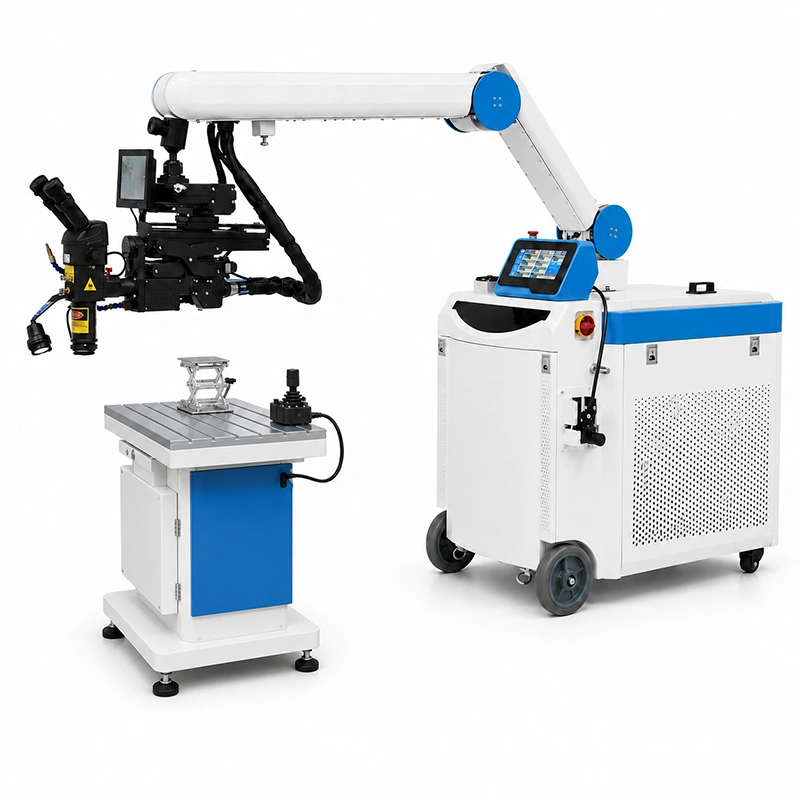
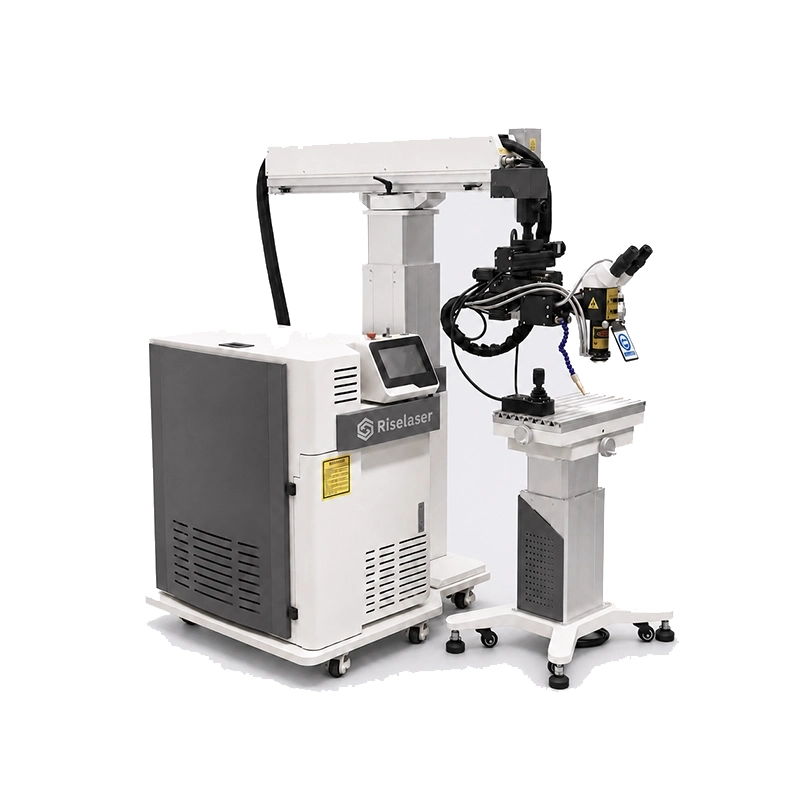
| Model | Distinctive Structure | Available Laser Configuration | Best Suited To |
|---|---|---|---|
| RLW-FQJJ Mobile Joint Arm |
Mobile base with a multi-joint articulated arm; approximately 1,600 mm maximum horizontal extension and 1,500 mm raised working height | QCW 200W/300W or CW 1500W/2000W |
Moving the machine around large injection, automotive, and die-casting molds; accessing different faces, cavities, and angles |
| RLW-FJ Jib Arm |
Stable floor-standing boom with 360° rotation, 600 mm motorized forward/backward travel, and 550 mm vertical lift | QCW 150W/300W or CW 1500W |
Large or floor-standing molds that need a stable overhead reach and controlled positioning into deep cavities |
| RL-YME Cantilever |
YAG pulse-welding platform with a 900 mm telescopic optical arm, rotating head, and electric lifting base | YAG 200W or 400W laser output |
Toolrooms that prefer traditional pulsed YAG processing for detailed mold and die repair |
What Can These Machines Repair?
Injection molds
Restore worn edges, small chips, scratches, pores, local dimensional errors, and damaged cavity features before machining, stoning, polishing, or texturing.
Die-casting and hot-work dies
Add material to localized wear, heat-check damage, corners, and repairable cracks after the defect has been properly inspected and prepared.
Stamping dies and tooling
Rebuild worn features and correct local machining errors where controlled heat input and accurate filler placement are important.
Large and difficult-to-move molds
Bring the welding head to the repair area instead of repeatedly lifting or transporting a heavy tool. Select the arm structure according to the required reach and approach angle.
For a general overview of suitable defects and repair methods, visit Laser Welding for Mold & Die Repair. For exact parting-line work, use the dedicated Injection Mold Parting Line Repair guide.

Choose the Machine by Repair Requirement
1. Start with the defect
Send the defect location, length, width, depth, and required final finish. A small edge buildup, a deep cavity repair, and a long continuous seam do not require the same configuration.
2. Confirm access around the mold
Measure the mold height, width, cavity depth, and distance from the machine base to the repair point. Also confirm whether the tool remains in a press, sits on the floor, or can be positioned on a worktable.
3. Select the laser process
- QCW fiber: Supports controlled pulsed repair, fine filler deposition, and heat-sensitive mold features.
- Pulsed YAG: Suitable for detailed manual repair where a traditional mold-welding pulse process is preferred.
- CW fiber: Suited to longer seams and faster continuous welding on suitable workpieces. Fine, heat-sensitive features usually require a more tightly controlled pulse process.
4. Select observation and motion control
Microscope observation supports direct manual control at the repair point. A CCD option can make training, documentation, and screen-based viewing easier. Electric axes help with repeatable straight movement, while manual fine positioning remains useful for irregular defects.
5. Validate the process before production repair
Provide the mold steel grade, hardness, filler wire, surface treatment, defect photos, and desired finish. Where practical, test on a matching sample or non-critical area before repairing a high-value tool.
Why Use a Dedicated Mold Repair Welding Machine?
- Position the head around large or complex molds without excessive tool handling.
- Deposit filler wire only where material is required.
- Limit heat input around precision surfaces and nearby details.
- Observe and control small repair areas through a microscope or camera system.
- Prepare the repaired area for machining, EDM, grinding, polishing, or texturing.
- Configure the system around the actual mold, material, and workshop electrical standard.

Information Needed for a Recommendation
Send the following details so Riselaser can recommend a configuration for the mold and repair:
- Mold or die type and overall dimensions
- Approximate mold weight and current location
- Steel or alloy grade and hardness, if known
- Defect type, size, depth, and position
- Required final tolerance and surface finish
- Photos or video showing access around the repair
- Available voltage and phase
- Preferred microscope or CCD observation
Frequently Asked Questions
Which mold repair laser welding machine is best for large molds?
Choose by access. The FQJJ is useful when a mobile multi-joint arm must approach several faces and angles. The FJ is better when a stable 360° jib or boom must reach a large floor-standing mold. The YME is a pulsed YAG cantilever option for detailed toolroom repair.
Does higher laser power always produce a better mold repair?
No. Fine edges, polished cavities, and heat-sensitive areas often require controlled energy, suitable spot size, correct pulse settings, and matched filler wire. More power can increase deposition capability, but it can also increase heat input if the process is not controlled.
Can the machine repair an injection mold without moving it to a fixed table?
Often, yes. The articulated-arm and jib-arm structures are designed to bring the welding head to large tooling. Final suitability depends on working clearance, safety controls, and access to the damaged feature.
Which mold steels can be evaluated?
Common requests include P20, H13, S7, NAK80, S136/420 stainless mold steel, 4140, and selected aluminum or copper alloys. The exact process and filler wire must be confirmed from the actual grade, hardness, defect, and finishing requirement.
Do you provide sample testing and training?
Riselaser can review samples, photos, or video and arrange a welding demonstration where practical. Remote training, an English manual, and one-to-one online support are available. An on-site demonstration may be possible where a suitable local customer or service resource is available.
What warranty is included?
The complete machine is covered for one year and the laser source for two years under the confirmed order terms. An extended warranty can be discussed for the selected configuration.
How long does delivery take?
Production and transit time depend on the model, options, electrical standard, and destination. Ask for the current lead time and shipping plan with the final quotation.
Start With the Mold Requirements
Send the material, mold dimensions, defect photos, repair depth, access requirements, and power supply. Riselaser will recommend the arm structure, laser source, observation system, and test-weld plan.
Request a Mold Welder Configuration →