
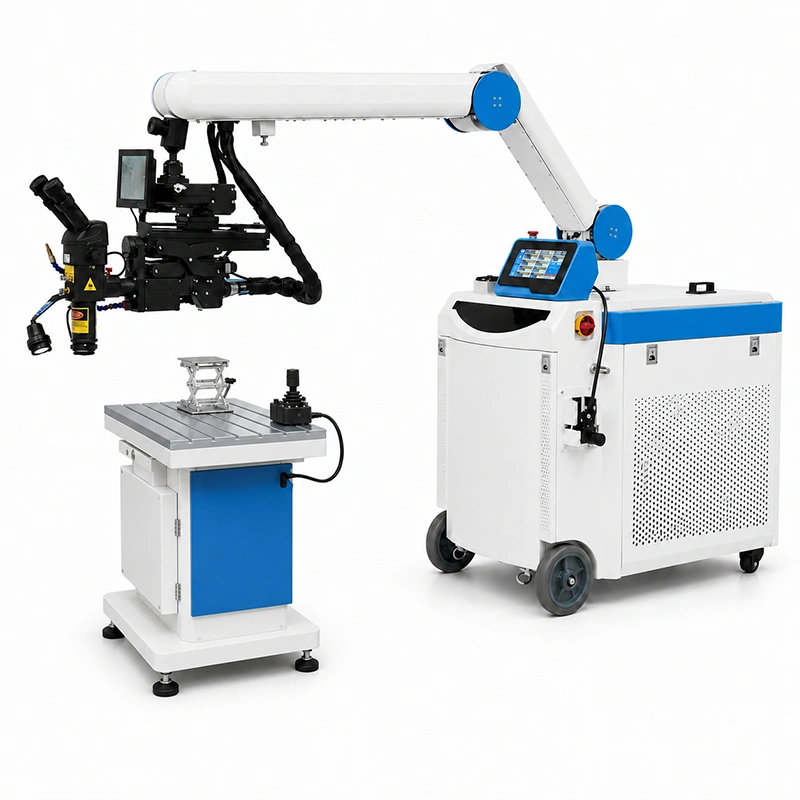
Large-mold repair without the relocation problem
Move the Welder. Leave the Mold in Place.
Bring precision laser repair to large injection, automotive, and die-casting molds instead of moving the workpiece to a fixed welding station.
The mobile base rolls to the job. The articulated arm then positions the microscope and welding head over the damaged area, including cavities, corners, vertical faces, and other hard-to-reach locations.
- Reduce lifting, rigging, and repeated mold handling
- Position the welding head around large or complex tooling
- Keep the operator close to the repair point for visual control

Repair near the production area
Move the compact welding system rather than repeatedly transporting a heavy mold to a separate workstation.
Reach more repair positions
Use the multi-joint arm and rotating head to approach edges, cavities, surfaces, and angled features.
Fine-position at the weld
Use the microscope, electric axes, and joystick controls to align the spot and guide filler-wire deposition.
Repair more than one defect type
Typical Mold Repair Applications
Use controlled filler-wire deposition to restore damaged features, correct machining errors, and rebuild worn areas before finishing.

Injection molds
Local repair of cavity features, edges, corners, scratches, pores, and machining defects.
Automotive and die-casting molds
Bring the welding head to larger tooling that is difficult or costly to relocate.
Tool and die repair
Rebuild worn or damaged areas before machining, grinding, polishing, or texturing.
Material examples: P20 and high-hard P20, 4140, A36, stainless steels, and selected aluminum alloys. Final parameters and filler-wire selection should be confirmed by the actual material, defect, and repair target.

Articulated working range
Reach the Repair—Then Fold the Arm Back
A long working envelope helps the welding head reach across large tooling while the foldable arm keeps the machine compact when repositioning or storing it.
- Approx. 1600 mm maximum horizontal extension
- Approx. 1500 mm raised working height
- Multi-joint positioning for different mold faces and cavities
- Compact folded footprint for workshop mobility
A lower-maintenance alternative to lamp-pumped systems
Stop Planning Around YAG Flashlamp Replacement
For precision mold repair, the QCW fiber option delivers pulsed energy without the replaceable flashlamp used by traditional lamp-pumped YAG machines.
More routine laser-source service items
- Flashlamps require periodic replacement
- More planned consumable cost and service interruptions
- Output condition can change as lamps age
Stable operation with fewer routine consumables
- No replaceable YAG flashlamp
- Routine spares are mainly protective lenses and copper nozzles
- Well suited to controlled filler-wire deposition and precision repair
Practical note: protective-lens and nozzle life depends on parameters, shielding gas, cleanliness, operating technique, and the repair environment. We recommend keeping sensible backup quantities rather than using a fixed replacement schedule.
Match the laser to the repair
Choose Precision Repair or Faster Continuous Welding
The same mobile articulated platform can be configured around different production priorities. Send us the mold material, defect, and expected build-up so we can recommend a practical starting point.
Fine repair work
A practical choice for controlled filling, edges, corners, small defects, and heat-sensitive mold features.
More repair capacity
Higher QCW output for customers who need more deposition capability while retaining pulsed process control.
Continuous welding
Suited to longer seams and general fabrication work where welding speed matters more than ultra-fine repair.
Higher throughput
For applications that need greater continuous power, penetration, or production speed on suitable parts.
Not sure which version fits? Material grade alone is not enough. Defect geometry, filler wire, repair depth, heat sensitivity, and surface-finish requirements all affect the recommendation.
Operator-centered positioning
Precision Control at Your Fingertips
Position the welding point without repeatedly walking between the mold and the machine cabinet.
- Three-axis joystick for articulated-arm positioning
- Microscope for direct observation of the weld area
- Quick parameter display near the welding head
- Electric XY travel of approx. 150 × 150 mm
- Approx. 100 mm vertical axis travel


Integrated working platform
One Mobile Platform. A Complete Repair System.
The laser source, water chiller, control system, articulated arm, observation system, and mobile chassis are integrated for shop-floor use.
- Articulated arm with multi-angle welding-head positioning
- Microscope observation and red-light aiming
- Integrated laser controls and water cooling
- Emergency stop, key switch, and main power control
- Industrial wheels for repositioning within the workshop
Machine demonstration
Watch the Articulated Arm in Operation
See how the mobile base, articulated joints, observation system, and welding head work together at the repair point.
Technical overview
Key Technical Specifications
Use these figures for initial evaluation. We will confirm the final configuration, electrical requirements, and included components before order.
| Item | QCW configuration | CW configuration |
|---|---|---|
| Available laser power | 200W / 300W | 1500W / 2000W |
| Primary use | Precision mold repair and controlled filler-wire deposition | Continuous welding and longer seams on suitable parts |
| Laser wavelength | Approx. 1080 nm | Approx. 1080 nm |
| QCW frequency | 1–30 Hz | Not applicable |
| QCW pulse width | 1–20 ms | Not applicable |
| Arm extension | Approx. 1600 mm maximum | |
| Raised working height | Approx. 1500 mm | |
| Electric axis travel | XY approx. 150 × 150 mm; Z approx. 100 mm | |
| Observation and aiming | Microscope observation with red-light aiming; camera system available | |
| Cooling | Integrated water cooling | |
| Shielding gas | Argon recommended for typical mold-repair processes | |
| Machine size | Approx. 1380 × 1000 × 1240 mm in folded configuration | |
| Power supply | Confirmed according to laser power and destination electrical standard | |
Specifications may change with the laser source, welding head, electrical standard, and optional equipment. Request a configuration sheet for the exact machine offered.
Support linked to your machine
Support Follows the Machine
Every machine carries a unique serial number on its nameplate, helping our after-sales team identify the configuration and support history.
2 years on the laser source
The complete machine is covered for 1 year. Warranty terms and exclusions are confirmed with the order.
Free remote operator training
We help your team learn setup, parameter adjustment, operation, routine checks, and basic troubleshooting.
Long-term technical support
A dedicated online service group can assist with parameter questions and technical issues. Overseas engineer training is available when required.
Buyer questions
Frequently Asked Questions
Should I choose QCW or CW for mold repair?
QCW is normally the starting point for precision mold repair, small defects, edge build-up, and applications sensitive to heat input. CW is better suited to continuous welding, longer seams, and higher production speed. We recommend the final version after reviewing your part and repair target.
Can the machine repair P20, 4140, stainless steel, or aluminum molds?
These are among the materials customers commonly ask us to evaluate. Weldability and the correct filler wire depend on the exact grade, heat treatment, defect, and finish requirement, so sample information is important before confirming the process.
What routine consumables should we keep?
The QCW fiber laser does not use a replaceable YAG flashlamp. Common backup items are protective lenses and copper nozzles. Their service life varies with operating conditions, so we recommend keeping a practical spare quantity on site.
Can you test our mold material before we order?
Yes. We support sample evaluation and welding demonstrations where practical. Send the material grade, defect description, dimensions, photos or video, and desired result so we can propose a test plan.
Is the machine difficult to operate?
The microscope, joystick, electric axes, and nearby parameter controls are designed for direct adjustment at the repair point. We provide free remote training and parameter support; overseas engineer training is also available when needed.
What happens if we need help after installation?
Use the machine nameplate and serial number when contacting us. Our after-sales team can identify the machine, review the issue, and support your team through the service group with troubleshooting and parameter guidance.
Start with the mold
Show Us the Repair. We’ll Help Plan the Process.
Send the material, defect size, repair depth, photos or video, and your power supply. We’ll reply with a recommended machine configuration and the next step for sample testing.