
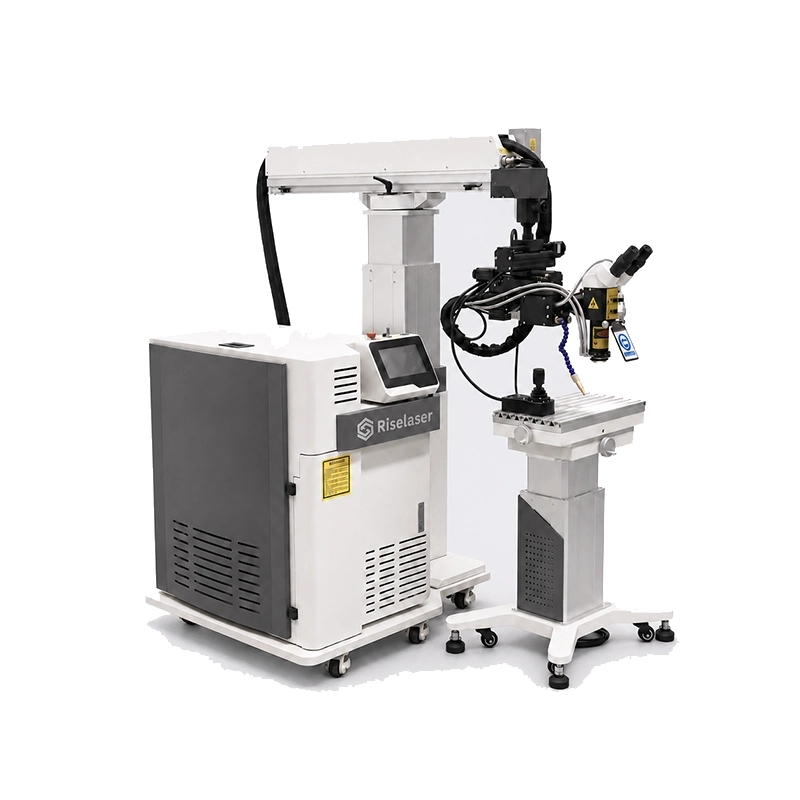
Position the Boom Around the Mold
360° working access
The jib structure rotates around the base so the welding head can approach different sides of a large tool. The universal head supports horizontal and angled positioning for cavity, edge, and surface repair.
Powered reach and lift
The 600 mm forward/backward stroke and 550 mm vertical lift help position the optical head over the repair area without repeatedly moving the mold.
Stable floor-standing layout
The separate boom base is suited to molds that remain on the floor or another support. Machine suitability still depends on reach, working clearance, floor condition, and the exact repair location.
Operator control at the repair point
Joystick positioning and microscope observation support fine alignment. Optional CCD, electric XY movement, rotary fixtures, and other accessories can be selected for the actual task.
Typical Welding Applications
- Large injection molds and automotive tooling
- Die-casting dies and heavy die blocks
- Deep cavity, edge, corner, pore, and local crack repair
- Dimensional buildup before CNC, EDM, grinding, or polishing
- Floor-standing tools that are difficult to place on a compact worktable
For worn sealing edges and corners, follow the injection-mold parting-line repair workflow before defining the buildup. This page covers only the RLW-FJ jib/boom configuration; compare mold welding machine structures when evaluating it against the FQJJ articulated arm and YME cantilever.

Select the Laser Configuration
QCW 150W
For fine pulsed repair, controlled filler deposition, and small heat-sensitive features.
QCW 300W
For greater pulsed deposition capability while retaining the control expected in precision mold repair.
CW 1500W
For longer seams and faster continuous welding on suitable workpieces where throughput is more important than micro-scale pulse repair.
Select the final source from the defect geometry, material, filler wire, heat sensitivity, and finishing requirement. Power is only one factor. Review QCW pulse welding for mold repair when the job requires controlled pulsed deposition on fine or heat-sensitive features.
Standard and Optional Configuration
Standard working package
RLW-FJ jib/boom positioning structure
Manual joystick control
Microscope observation
Workbench or floor-standing working arrangement as confirmed
Integrated cooling and control system for the selected source
Optional upgrades
Trinocular CCD camera and display
Electric XY motion for controlled straight travel
D80 or D100 rotary fixture for suitable round parts
Alternative welding head where wider or oscillating deposition is required
All included components must be listed on the final quotation because source, head, control, and electrical packages can differ.

Technical Specifications
Parameter | QCW-150W-DB | QCW-300W-DB | CW-1500W-DB |
Laser output | 150W | 300W | 1500W |
Primary process | Pulsed precision repair | Pulsed repair with greater deposition | Continuous welding on suitable workpieces |
Wavelength | 1080 ± 10 nm | 1080 ± 10 nm | 1080 ± 10 nm |
Frequency | 1–30 Hz | 1–30 Hz | Confirm for selected source/control |
Pulse width | 1–20 ms | 1–20 ms | Not presented as a QCW pulse specification |
Spot range | 0.2–3 mm | 0.2–5 mm | 0.2–5 mm |
Observation | Microscope standard; CCD optional | Microscope standard; CCD optional | Microscope standard; CCD optional |
Jib rotation | 360° working rotation | 360° working rotation | 360° working rotation |
Powered horizontal travel | 600 mm | 600 mm | 600 mm |
Vertical lift | 550 mm | 550 mm | 550 mm |
Machine dimensions | Approximately 1650 × 920 × 1150 mm | Approximately 1650 × 920 × 1150 mm | Approximately 1650 × 920 × 1150 mm |
Power supply | Confirm for final source and destination | Confirm for final source and destination | Confirm for final source and destination |
FJ, FQJJ, or YME?
- Choose RLW-FJfor a stable 360° boom around large or floor-standing molds.
- Choose RLW-FQJJfor a mobile base and multi-joint articulated reach across several faces and angles.
- Choose RL-YMEfor a traditional 200W/400W pulsed YAG cantilever platform.
Choose by required reach, working clearance, positioning stability, source behavior, and repair geometry rather than from a single power figure.

Certified Quality & Safety

CE Certified Safety
Fully compliant with EU health, safety, and environmental protection standards. Ensures the machine is safe to operate and ready for the European market.

FDA Accession Number
Officially registered with the U.S. FDA (CDRH). We provide a valid Accession Number for smooth customs clearance and legal usage in the United States.

ISO 9001 Quality System
Our manufacturing process is certified by ISO 9001 standards. Every machine undergoes strict quality control and testing before shipment to ensure reliability.
Flexible Shipping Solutions Worldwide
🏭 Ship to Your Agent (China) If you already have a forwarder in China (e.g., in Guangzhou or Yiwu), we can ship the machine directly to their warehouse for free.
✈️ Standard Air Freight (DAP) If you have import experience, we can arrange shipping via DHL/FedEx/UPS to your airport or door. You handle the customs clearance upon arrival.
🚪 Hassle-Free DDP Service (Recommended) No import experience? No problem. We offer DDP (Delivered Duty Paid) service. We handle shipping, customs clearance, and tax payments. The machine is delivered straight to your door—you just wait and sign for it!
Frequently Asked Questions
Can the RLW-FJ work on a mold that is too heavy for its workbench?
The boom can be arranged to reach floor-standing tooling, so the mold does not have to sit on the standard workbench. Confirm mold dimensions, support, floor layout, reach, and safety clearance before ordering.
What is the difference between a jib arm and an articulated arm?
A jib uses a stable rotating boom with defined powered travel. An articulated arm uses multiple joints for more flexible approach angles and a foldable mobile structure.
Should I choose QCW or CW?
QCW is the normal starting point for precision pulse repair and controlled filler deposition. CW is more suitable for continuous seams and higher welding speed on appropriate workpieces.
What support is provided?
Remote training/site training, an English manual, online technical support, and configuration-specific after-sales service are available. Warranty terms are confirmed with the order.