
When facing damaged tooling, mold repair welding is the crucial first step to getting your press back online without compromising part quality.
Laser welding is the definitive, industry-standard solution for repairing injection mold parting lines and corners because it eliminates the thermal distortion, deep heat-affected zones (HAZ), and premature wear associated with traditional Tungsten Inert Gas (TIG) welding. By using highly focused light to melt microscopic filler wire, laser welding restores sharp edges and critical shut-offs to original Original Equipment Manufacturer (OEM) tolerances without pre-heating. This process drastically reduces production downtime, eliminates flash, and generates a rapid return on investment.
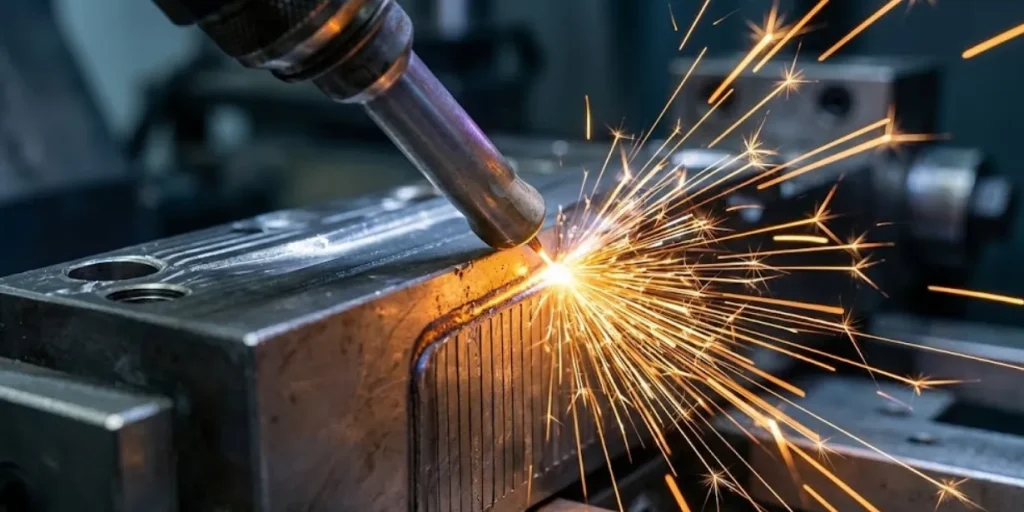
Why Do Injection Mold Parting Lines and Corners Fail?
Heavy clamping tonnage causes hobbing, while abrasive glass-filled resins scour and degrade sharp corners over time. This wear leads directly to flashing on high-cavitation molds and trapped gas burns, ultimately forcing tooling managers to pull the tool and halt production.
For a tooling manager, nothing is more frustrating than seeing flash on high-cavitation molds. It ruins part aesthetics, damages your scrap metrics, and forces unexpected downtime. When abrasive resins wear away shut-offs, or when repetitive clamping pressure crushes delicate parting lines, the structural integrity of the mold degrades. Left unchecked, this wear forces complete mold teardowns.
Laser Welding vs. Micro-TIG: Which is Better for Precision Mold Repair?
Laser welding is up to four times faster than Micro-TIG, requires no pre-heating, and prevents warping on delicate parting lines. Its pinpoint accuracy eliminates thermal distortion, making it the superior choice for high-precision injection mold restorations.
When evaluating a laser welder for mold repair, understanding the limitations of legacy systems is critical. TIG welding requires significant heat input, which creates a host of secondary problems for delicate tooling.
| Feature | Laser Welding | Micro-TIG Welding |
| Speed | Fast (Up to 4x faster) | Slow |
| Heat-Affected Zone | Microscopic (0.008″ – 0.012″) | Deep (Up to 0.15″) |
| Risk of Distortion | Very Low | High |
| Pre-heating Required | No | Yes |
Heat-Affected Zone (HAZ) and Hardness Retention
Laser welding generates a microscopic HAZ of just 0.008 to 0.012 inches, compared to TIG’s 0.15-inch HAZ. This minimal heat input prevents localized annealing, completely eliminating the “soft spots” that cause traditional TIG repairs to fail after just a few months.
Those soft spots are the primary reason a repaired mold flashes again shortly after going back into the press. Laser welding preserves the base metal’s original hardness, ensuring your repair lasts as long as the virgin steel.
Tackling Sharp Radii and Textured Surfaces
Unlike TIG welding, where arc wander can destroy sharp parting lines and surrounding details, laser precision allows operators to rebuild exact edges while fully preserving adjacent textured surfaces and intricate geometries.
The 5-Step Process for Laser Welding Parting Lines and Corners
Investing in a reliable laser welding machine for mould repair is only half the equation; executing a rigorous, repeatable process ensures a hermetic seal and a permanent fix.

1. Excavation (The U-Groove Rule)
Technicians must grind cracks into a smooth U-shape using a ball-nose burr rather than a sharp V-groove. A U-shape prevents the laser beam from becoming trapped and eliminates root voids that compromise the weld’s integrity.
2. Chemical Cleaning and Pre-Melting
First, strip all oils and coolants from the cavity using acetone. Next, run a “wash pass” with the laser—firing the beam without adding filler wire—to burn off microscopic impurities and prepare the base metal for bonding.
3. Sidewall Buttering and Root Passes
Buttering involves building up the left and right walls of the excavated groove first before filling the center. This guarantees total edge fusion and prevents the weld bead from pulling away from the base metal under stress.
4. Pulse Overlap and Density Control
Operators must maintain a 70% to 80% pulse overlap during the welding pass. This tight overlap floats trapped gas bubbles out of the weld puddle, ensuring a dense, watertight seal capable of withstanding massive injection pressure.
5. The Cap Pass and Overfilling
The final cap pass is intentionally overfilled by approximately 0.005 inches. The operator defocuses the laser beam to smooth out surface ripples, leaving just enough excess material for the machinist to mill down to the final OEM tolerance.
Choosing the Best Filler Wire for P20, H13, and S7 Tool Steels
Filler wire must match the base steel’s metallurgical properties to prevent untempered martensite cracking. Use P20 wire for lower-volume runs (up to 100,000 cycles) and H13 wire for high-volume, abrasive molds exceeding 100,000 cycles.
Selecting the wrong filler wire leads to brittle welds and catastrophic failure under clamping pressure. Always match the alloy chemistry and hardness:
- P20 Tool Steel: Ideal for general-purpose molds, bumpers, and large housings. Reliable up to 100k cycles.
- H13 Tool Steel: Built for thermal fatigue resistance. Mandatory for high-volume, high-heat molds pushing well past 100k cycles.
- S7 Tool Steel: Best for applications requiring maximum shock resistance.
Post-Weld Finishing: Machining and Polishing the Weld Deposit
Can laser welds be polished to a mirror finish? Yes. Because laser welding creates a dense, fine-grained microstructure without porosity, the weld deposit can be Computer Numerical Control (CNC) machined, Electrical Discharge Machining (EDM) stoned, and polished back to an SPI A-1 mirror finish without leaving a visible “ghost” outline.
This flawless finish is critical for optical lenses, clear plastics, and highly cosmetic consumer goods where even a microscopic weld line would result in part rejection.

Calculating the ROI: In-House Laser Welding vs. Outsourcing
Eliminating just one week of outsourced shipping downtime easily pays for a $5,000 to $7,000 1.5 kW laser welding machine. The barrier to entry is low, and the immediate reduction in scrap delivers an instant return on investment.
Reduced Downtime and Scrap Elimination
When flashing occurs, pulling the tool, creating it, and shipping it to an outside weld shop takes days. Mobile, articulated jib-arm laser systems allow you to repair molds while they are still in the press. You save days of teardown time and immediately stop flash-related scrap right on the production floor.
Equipment Payback Period and Training
We are facing a massive shortage of highly skilled TIG welders. Fortunately, modern handheld laser welders are highly intuitive. General maintenance workers and tooling technicians can be trained to perform precise repairs quickly, offsetting labor shortages and drastically accelerating your ROI timeline.
Safety Notice: Laser welding requires strict adherence to safety protocols. Always operate Class 4 laser equipment within properly enclosed areas using interlocks, fume extraction systems, and certified laser safety eyewear specific to your machine’s wavelength.
Ready to Eliminate Tooling Downtime?
Stop accepting soft spots, flash, and weeks of outsourced downtime.
Contact our Riselaser technical team today for mold laser repair solutions and to customize a suitable mold laser welding machine for your production line. Let us run a sample weld trial on your scrap steel to prove the results.


