
Injection mold repair is often possible when damage is localized and the mold base, critical datums, and major structural parts remain sound. It becomes less attractive when a tool has structural cracking, repeated failures, obsolete components, extensive dimensional loss, or recovery costs close to replacement. This guide helps you separate mold damage from processing problems, select a repair method, and decide whether repair, refurbishment, or a new mold offers the lowest production risk.
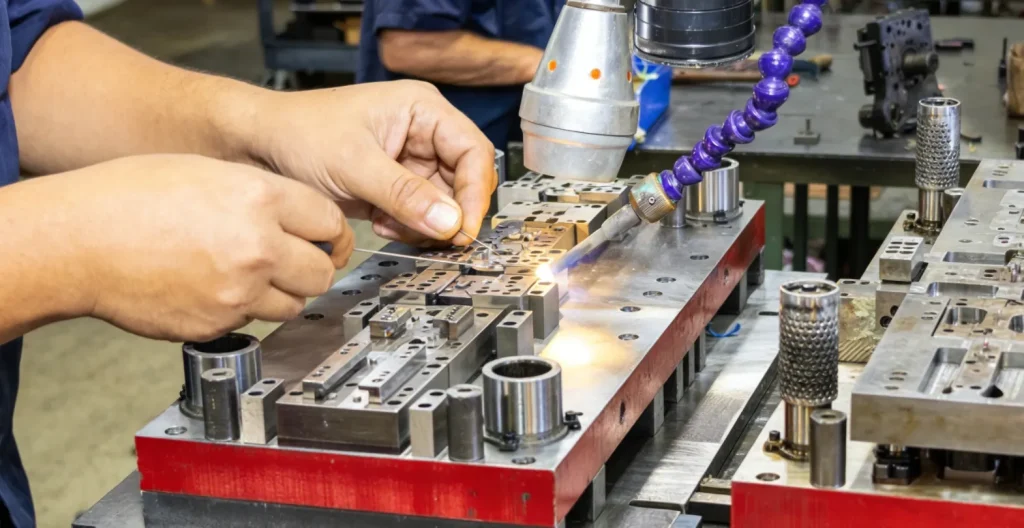
Can an Injection Mold Be Repaired?
Yes. Repairability depends on defect location and severity, root cause, tool age, tolerance, previous repairs, and remaining volume. Common candidates include local wear, chipped parting lines, failed ejector parts, blocked water lines, corrosion, scratches, and some non-structural cracks.
- Repair: Correct localized damage or replace individual components.
- Rebuild/refurbishment: Restore several systems while retaining a serviceable mold base.
- Replacement: Manufacture a new mold or major structural mold section.
Cracks through a cavity block or load-bearing plate, lost datums, unsupported hot-runner parts, or repeated failure require engineering review—not an automatic weld repair.
What Signs Show That an Injection Mold Needs Repair?
Production teams usually see the part defect first. Signs include flash around a parting line, shutoff, or ejector pin; dimensional drift; cavity-to-cavity variation; scratches; drag marks; sticking; uneven ejection; broken core pins; gate erosion; leaks; corrosion; rising cycle time; warpage; short shots; or burn marks near damaged vents.
We first document whether the defect repeats in one mold cavity and location, then inspect the matching core, cavity, insert, ejector, or cooling area. A visible crack does not prove welding is the answer.
| Observed symptom | Possible mold-related cause | Inspect | Likely action | Verify after repair |
|---|---|---|---|---|
| Flash | Debris, parting-line wear, insert movement, misalignment | Parting surface, shutoffs, guide system | Clean, align, weld, or re-machine | Seal and flash-free samples |
| Longer cycle | Restricted cooling channel | Flow, pressure drop, thermal pattern | Clean or rebuild circuit | Flow and cycle time |
| Sticking/ejection marks | Worn or misaligned ejectors | Pins, sleeves, ejector plate, mold cavity finish | Replace, align, polish | Repeated smooth ejection |
| Dimensional drift | Cavity wear, shifted insert, cooling imbalance | Critical dimensions and cavity balance | Re-machine, replace insert, rebalance cooling | Dimensional and sample approval |
Before altering the tool, rule out clamp force, injection pressure, resin condition, melt temperature, mold temperature, and other process settings.
How to Diagnose and Repair an Injection Mold
A reliable repair follows a documented workflow. Diagnosis and production validation matter as much as the physical work.
1. Document the defect and production history
Record the cavity, shot count, location, process changes, prior repairs, cycle time, and downtime. Retain defective parts for comparison.
2. Inspect, measure, clean, and disassemble
Use visual inspection, magnification, measurement, cooling-flow tests, and safe disassembly. Dye penetrant testing can reveal surface-connected cracks; ASTM E1417/E1417M defines minimum process requirements.
A crack opening may hide deeper damage. Clean it, remove fatigued or contaminated steel, and inspect again. Remaining indications mean preparation is incomplete. See this step-by-step guide to repair cracks.
3. Correct the root cause
Check clamp force, guide wear, blocked cooling, lubrication, component interference, misalignment, and mold material choice. Thermal imaging, 3D scanning, or Moldflow analysis may help with complex cooling, filling, or warpage problems. For example, these diagnostic tools can pinpoint the thermal imbalances that lead to high temperatures drag marks during part ejection.
4. Repair, reassemble, and validate
Repair or replace affected parts. Confirm seating, alignment, lubrication, cooling connections, and movement of ejectors, slides, and lifters. Trial-mold the tool and validate repeatability before release.

What Injection Mold Repair Methods Are Used?
Method selection depends on distortion, machining effort, recurrence risk, steel grade, hardness, finish, and defect geometry, and when reconditioning is the goal, how worn areas will be restored to their original condition.
| Method | Best suited to |
|---|---|
| Cleaning and polishing | Residue, light corrosion, minor surface damage |
| Component replacement | Ejector pins, sleeves, seals, guide parts, and bushings |
| Computer numerical control (CNC), grinding, or electrical discharge machining (EDM) | Datums, gates, runners, shutoffs, and dimensional surfaces; EDM is especially useful for restoring intricate parts in cavity details without high heat stress |
| New core or insert | Damage too extensive for reliable buildup |
| Laser welding | Small cracks, chips, worn corners, parting lines, and precision areas |
| Laser cladding or laser metal deposition (LMD) | Worn cavities, cores, edges, and larger-area dimensional buildup; localized wear- or corrosion-resistant overlays |
| Tungsten inert gas (TIG) or micro-TIG | Larger buildup where more heat and machining are acceptable |
| Cooling-circuit service | Scale, restricted flow, leakage, and uneven cooling |
| Coating or surface treatment | Wear, corrosion, release, or service-life improvement after restoration |
After machining, surface grinding corrects slight imperfections on mold surfaces, and precision grinding machines are used to remove surface impurities on molds.
When Is Laser Welding Suitable for Mold Repair?
Laser welding is a precise repair method for intricate parts that minimizes heat impact on surrounding surfaces, helping protect nearby details while adding material with extreme precision. Filler wire must suit P20, H13, S7, NAK80, or S136/420 stainless, and the area may still need CNC machining, EDM, grinding, polishing, texturing, and inspection. Proper preheating and compatible filler metals help avoid cracking in welding repairs. Despite the equipment cost, the process can improve cost effectiveness by reducing labor costs and eliminating some pre-welding hand work.
Consumable, preheat, hardness, and post-treatment decisions are material-specific. See also our guide to choosing the right laser welding wire for mold steel.
Laser welding is not suitable by default for deep structural cracks, extensive material loss, or a compromised mold base. Qualified technicians must apply controls for the laser welder’s stated laser class, including guarding, interlocks, personal protective equipment (PPE), shielding gas, and fume extraction; that ability does not change the safety guidance. ISO 11553-1:2020 addresses laser-processing-machine safety.
When Should You Repair, Rebuild, or Replace an Injection Mold?
Repair a localized problem, rebuild a serviceable tool with system-level wear, and replace a structurally compromised or economically obsolete tool. Make the decision using expected production risk and total recovery cost—not an arbitrary percentage of a new mold’s price, especially when a tool running under high pressure or repeated thermal cycling shows deformation or recurring alignment loss.
| Choose repair when… | Choose rebuild when… | Choose replacement when… |
|---|---|---|
| Damage is localized and measurable | Several related systems are worn | Structural plates or cavity blocks are severely cracked |
| Mold base and critical datums are sound | Mold base remains valuable | Datums or alignment cannot be restored reliably |
| Individual components can be replaced | Cavities, inserts, cooling, runner, or ejection systems need coordinated renewal | Design or resin requirements exceed practical modification |
| Failure is isolated | Repeated issues indicate system-level wear | Earlier repairs repeatedly fail |
| Repair can cover the remaining demand | Remaining volume supports an overhaul | The rebuild offers little reuse value |
| Validation risk is acceptable | Requalification is practical | Regulated or critical parts cannot accept the residual risk |
Review damage, mold age, shot history, repair frequency, remaining volume, tolerances, finish, and downtime. Check computer-aided design (CAD) files, steel data, spare components, hot-runner support, whether prior repairs still meet the same exacting standards as the original tool, whether the mold can continue to produce conforming parts, and the cost of another failure.
For medical, optical, safety-critical, or Production Part Approval Process (PPAP) programs, involve quality and customer teams before accepting residual risk. Repairs should restore the tool to the same exacting standards expected in production, especially when repeated fixes have accumulated.
How Much Does Injection Mold Repair Cost?
There is no reliable universal price. A defensible estimate includes available repair services, not just a single welding step:
- Inspection and root-cause analysis
- Welding, EDM, CNC machining, grinding, and polishing
- Replacement components or new inserts
- Mold removal, transport, disassembly, and reassembly
- Trial molding
- Coordinate measuring machine (CMM) inspection
- First-article inspection, PPAP, or requalification
- Production downtime
- The probability and cost of another failure
Focus on total recovery cost, not only the repair invoice. Complex tooling for larger production runs can cost $5,000–$100,000, illustrating why repair economics must be calculated for the actual tool and production program, and laser welding may improve cost effectiveness by reducing labor-intensive prep and finishing compared with higher-heat alternatives.

How Should a Repaired Injection Mold Be Validated?
A good-looking weld does not prove production readiness. Release the mold only after dimensional, functional, and process checks show stable output.
- Confirm critical molded-part dimensions against the drawing.
- Inspect flash, parting lines, shutoffs, repaired surfaces, polish, and texture.
- Confirm flat sealing and parting surfaces where required.
- Check ejector, slide, lifter, guide, and hot-runner operation.
- Measure cooling flow and inspect for leaks.
- Compare cavity-to-cavity consistency.
- Confirm cycle time against an approved baseline.
- Verify the two halves align correctly in the press.
- Run enough consecutive cycles to expose repeatability problems.
- Obtain first-article, CMM, or customer approval where required.
- Record the repair, measurements, settings, and next inspection trigger.
Validation should also confirm there are no burrs or sharp edges left from repair or finishing work.
ISO 20457 provides a reference framework for manufacturing tolerances on plastic molded parts, but the product drawing and customer requirements remain controlling.
How Can Repeat Mold Failure Be Prevented?
Use condition- or cycle-based inspection rather than one interval for every tool. Clean cavities, vents, and parting surfaces; monitor water quality and cooling flow; use approved lubrication; control clamp force and alignment; and protect molds from corrosion in storage.
Track repairs by cavity and component, document root causes, and stock critical wear parts. Inspection frequency should reflect tool construction, resin abrasiveness, production volume, operating history, and manufacturer guidance.
After a major repair, I recommend recording more than the date and the words “mold welded.” The repair history should identify the affected cavity, original symptom, damage location and depth, removed material, mold steel, filler wire, repair method, inspection results and shot count at the next review.
FAQs
Can injection molds be repaired?
Yes. Local wear, component failure, surface damage, and some cracks can be repaired when dimensions are recoverable and the mold base and structural components remain sound. The repair must also meet tolerance, surface-finish, repeatability, and validation requirements for the molded part.
What types of injection mold damage can be repaired?
Repairable damage often includes scratches, chipped edges, worn parting lines or shutoffs, gate erosion, damaged ejector pins or sleeves, blocked cooling channels, corrosion, and localized cracks. Extensive structural damage may require a new insert, core, cavity block, major rebuild, or complete mold replacement.
How much does it cost to repair an injection mold?
Cost depends on defect location, tool steel, access, welding or machining time, replacement parts, finish, trial molding, inspection, and downtime. Compare the complete recovery cost and risk of recurrence with rebuilding and replacement—not simply the quoted welding charge.
When should an injection mold be replaced instead of repaired?
Replacement becomes more suitable when structural sections are severely cracked, critical datums cannot be restored, repairs keep failing, tolerances are lost, key hot-runner or control parts are obsolete, the product changes substantially, or another failure would create unacceptable quality or supply risk.
How long does an injection mold last?
Mold life is measured in cycles, not calendar years. It varies with mold class, design, steel or aluminum grade, resin abrasiveness, processing conditions, maintenance, repair history, and prolonged exposure to high temperatures or high pressure. Use the tool specification, shot count, condition data, and part-quality trend instead of assuming a universal lifespan. Where the tooling environment includes titanium-compatible components, repairs may require specialized support.
Can laser welding repair a cracked injection mold?
Laser welding can restore many localized cracks and worn features with controlled material addition and limited heat input. First evaluate crack depth, location, tool steel, hardness, stress, contamination, and structural importance. The repair still needs suitable filler wire, finishing, dimensional inspection, and production validation.
Make the Decision From Evidence, Not the Visible Defect
In my view, an injection mold should be repaired when the damage is localized, its cause can be identified, the affected material can be completely removed and the repaired feature can be measured and production-tested.
For a repairability review or help selecting mold repair laser welding machines, share defect photos, steel grade, affected dimensions, shot history, and finish requirements with Riselaser.


